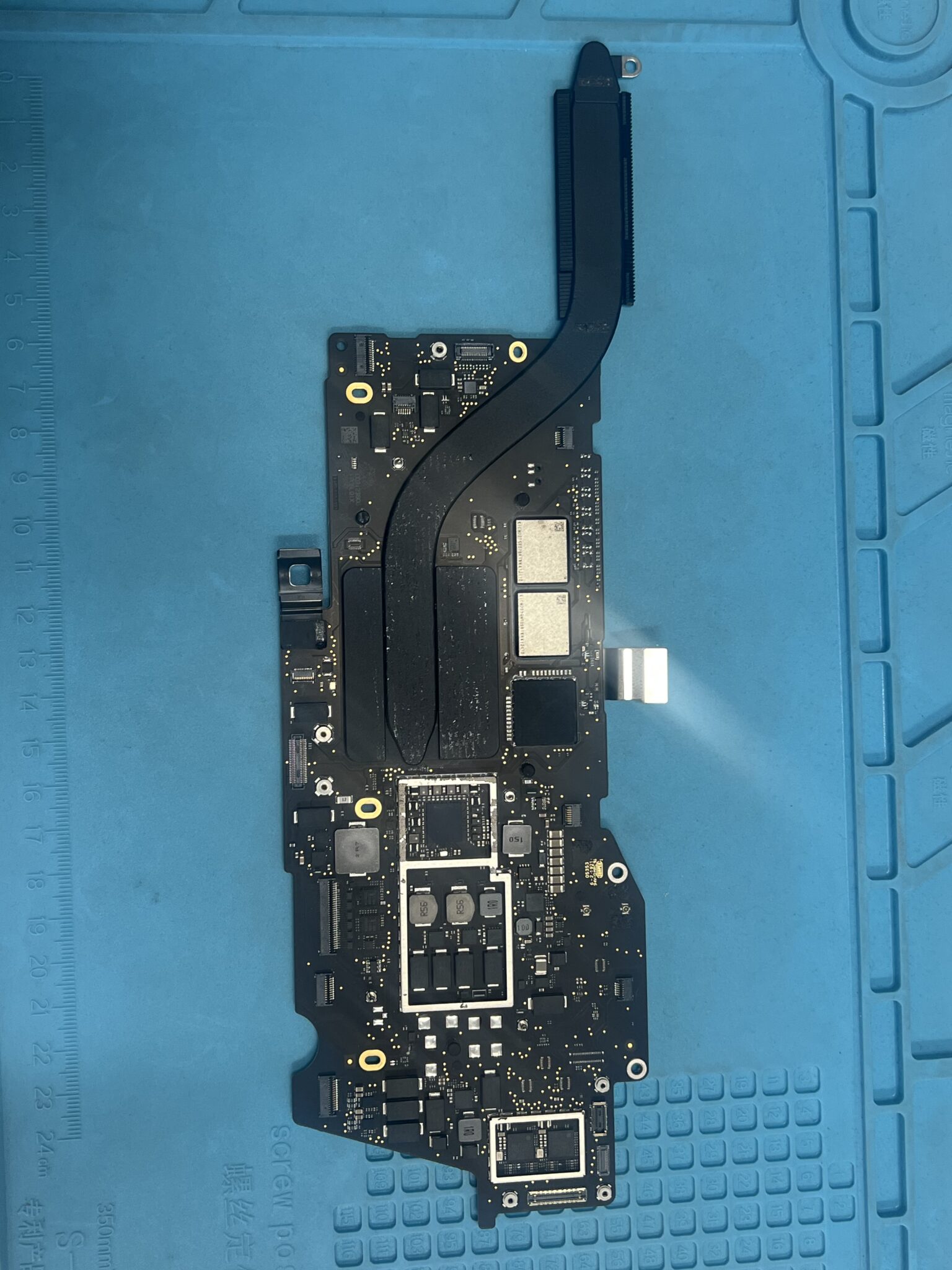
820-02020 A2338 No Power Repair – R5262 Open in Charging Circuit
This 13-inch MacBook Pro A2338 with logic board 820-02020 came in with a customer report of:
- water damage
- no power
On initial testing, both USB-C ports showed:
5V / 0.12A, repeatingThe machine was not reaching normal power-up. Instead, it kept attempting to start and then falling back again.
Initial Symptom
The key early symptoms were:
- Both USB-C ports behaved the same
- Current stayed at 5V / 0.12A and repeated
- PPBUS_G3H was not stable
The PPBUS_G3H measurement was especially important. Instead of staying near a stable power rail level, it repeatedly moved:
12.3V → 4V → 12.3V → 4VThat meant the machine was trying to start, but the main power path was collapsing during the attempt.
Measurements Table
| Test Point / Observation | Reading |
|---|---|
| USB-C port 1 | 5V / 0.12A repeating |
| USB-C port 2 | 5V / 0.12A repeating |
| PPBUS_G3H | 12.3V dropping to 4V repeatedly |
| R5262 measured | >1kΩ |
| R5262 expected | 1Ω |
| After repair | MacBook powered normally |
Why the Charging Circuit Was Suspected
The reason for suspecting the charging / power-path circuit was the combination of symptoms.
If the fault had been isolated to one USB-C port, you would usually expect different behaviour between the two ports. But here, both USB-C ports showed the same repeating 5V / 0.12A pattern, which suggested the problem was not local to one port, but in a common power path.
The second clue was PPBUS_G3H instability. PPBUS_G3H is one of the main always-present power rails. In a healthy board, it should not repeatedly fall from 12.3V down to 4V during a simple power-up attempt.
That repetitive collapse strongly suggested:
- the board was trying to start,
- the power path could not sustain the load,
- and the problem was likely in the charging / input power circuit rather than in a later secondary rail.
In short:
Both ports same behaviour = likely common circuit fault
PPBUS_G3H collapsing = power path not stable
Therefore suspect charging / input circuit first
Circuit Logic
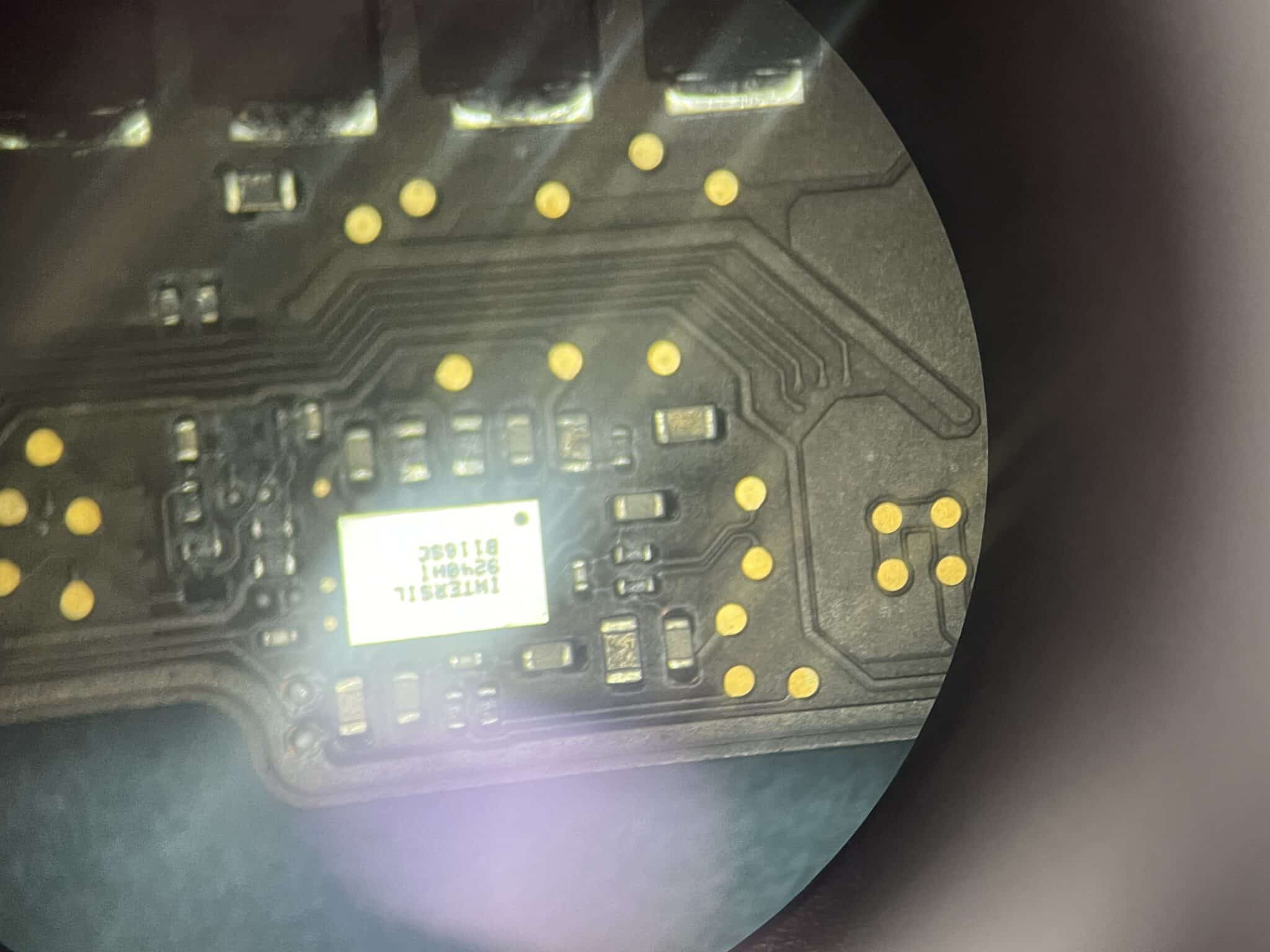
R5262 was the key part in this case.
When measured, R5262 read more than 1kΩ, but it should have been 1Ω. That is a major fault. A resistor that should be very low resistance but instead measures extremely high can interrupt or distort the intended current path.
In practical board-level diagnosis, when a low-value resistor in the charging path goes open or high-resistance:
- the board may still show some life,
- the charger may remain at 5V,
- the system may repeatedly attempt to start,
- but the main rail can collapse because the charging/power path is no longer behaving correctly.
That matched this case very well.

Repair Timeline
| Step | Result |
|---|---|
| Customer reported water damage and no power | Confirmed |
| Tested both USB-C ports | Both showed 5V / 0.12A repeating |
| Measured PPBUS_G3H | Jumped from 12.3V to 4V repeatedly |
| Suspected charging / power-path fault | Common-circuit direction confirmed |
| Tested components in charging area | R5262 measured >1kΩ |
| Compared with expected value | Should be 1Ω |
| Replaced R5262 | Board recovered |
| Final test | MacBook fully working |
Key Lesson
When both USB-C ports show the same repeating 5V / 0.12A behaviour, do not focus only on the ports themselves. That often points to a shared input or charging circuit fault.
In this case, the strongest clue was:
PPBUS_G3H repeatedly collapsing from 12.3V to 4VThat told us the board was trying to start but could not maintain the power path.
The final fault was simple but critical:
R5262 >1kΩ, should be 1ΩReplacing R5262 restored stable power and normal operation.
Final Fix
The final repair was:
- diagnose no-power / repeating-start condition,
- observe both USB-C ports behaving the same,
- confirm unstable PPBUS_G3H,
- test charging-path components,
- identify R5262 as faulty,
- replace R5262,
- confirm the MacBook powered and worked normally again.
Final result:
- power restored
- normal start-up
- MacBook fully functional
Case Summary
| Item | Details |
|---|---|
| Device | MacBook Pro 13-inch |
| Model | A2338 |
| Logic board | 820-02020 |
| Customer fault description | Water damage, no power |
| USB-C readings | Both ports: 5V / 0.12A repeating |
| Main rail behaviour | PPBUS_G3H jumped from 12.3V to 4V repeatedly |
| Suspected area | Charging / power-path circuit |
| Failed component | R5262 |
| Measured value | More than 1kΩ |
| Expected value | 1Ω |
| Repair | Replaced R5262 |
| Final result | MacBook fully working |
This board repair is one example from our component-level Mac repair case library. You can view more logic board diagnosis and repair notes here:
Mac Logic Board Repair Case Studies
Need Board-Level Mac Repair?
If you have a MacBook with no power, water damage, stuck 5V charging, or unstable main rail behaviour, contact IT-Tech Online.
We specialise in MacBook logic board repair in Melbourne, including fault tracing down to individual components.